

Does the color of moissanite change under different lighting conditions?
Jul 10, 2025
Leave a message
As a supplier of color moissanite, I've received numerous inquiries about whether the color of moissanite changes under different lighting conditions. This question is not only crucial for consumers who are looking to purchase moissanite jewelry but also for those in the industry who want to understand the nuances of this beautiful gemstone. In this blog post, I'll delve into the science behind moissanite's color and how it can appear differently depending on the lighting.
Understanding Moissanite's Color
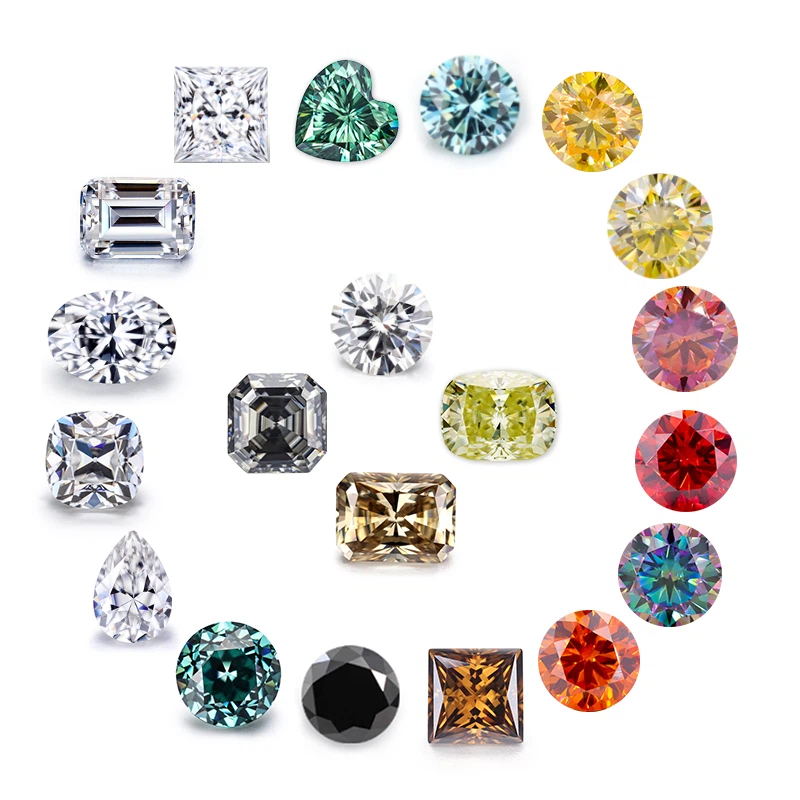
Moissanite is a lab - created gemstone that has gained popularity as an alternative to diamonds. Natural moissanite is extremely rare, and most of the moissanite available in the market today is synthesized in a laboratory. Color moissanite, in particular, comes in a variety of hues, including but not limited to yellow, green, pink, Coloured Moissanite, Gray Moissanite, and Dark Grey Moissanite. The color in moissanite is often a result of trace elements or structural defects during the creation process.
The Role of Lighting in Color Perception
Lighting plays a significant role in how we perceive the color of any gemstone, and moissanite is no exception. Different types of light sources emit light with varying spectral distributions, which can interact with the gemstone in different ways.
Natural Sunlight
Sunlight is a full - spectrum light source, meaning it contains all the colors of the visible spectrum. When moissanite is exposed to natural sunlight, its true color is most accurately revealed. The full - spectrum nature of sunlight allows the gemstone to display its color in the most vivid and accurate way. For example, a yellow moissanite will appear bright and vibrant, and the subtle undertones of a Gray Moissanite can be clearly seen. The natural balance of light in sunlight also enhances the moissanite's brilliance and fire, making it sparkle more effectively.
Incandescent Lighting
Incandescent bulbs produce light by heating a filament until it glows. This type of light has a warm color temperature, with a higher proportion of red and orange wavelengths. Under incandescent lighting, moissanite may appear warmer in color. A colorless or near - colorless moissanite might take on a slight yellowish tint, while colored moissanites may have their warm - toned colors enhanced. For instance, a pink moissanite could look more intense and rosy under incandescent light.
Fluorescent Lighting
Fluorescent lights work by exciting mercury vapor to produce ultraviolet light, which is then converted into visible light by a phosphor coating inside the tube. Fluorescent lighting has a more uneven spectral distribution compared to sunlight. It often has peaks in certain wavelengths and may lack others. As a result, moissanite under fluorescent lighting may appear duller or have a slightly off - color appearance. Some colors may look washed out, and the overall sparkle of the gemstone can be diminished.
LED Lighting
LED lights are becoming increasingly popular due to their energy efficiency and long lifespan. There are different types of LED lights with varying color temperatures. Cool - white LED lights have a high color temperature and a more bluish tint, while warm - white LED lights are closer to the color temperature of incandescent bulbs. Under cool - white LED lighting, moissanite may appear cooler in color, with blue undertones being more prominent. A Dark Grey Moissanite might look more steely and less warm - toned compared to how it appears in sunlight.
Factors Affecting Color Change
Apart from the type of lighting, there are other factors that can influence how moissanite's color changes under different lighting conditions.
Gemstone Quality and Cut
The quality and cut of the moissanite can affect how it interacts with light. A well - cut moissanite will reflect and refract light more effectively, enhancing its color and sparkle regardless of the lighting. In contrast, a poorly cut moissanite may not display its color as accurately or may have uneven light distribution, making it more susceptible to color changes under different lighting.
Color Intensity
The intensity of the color in moissanite also matters. A moissanite with a strong, saturated color is less likely to have its color significantly altered by different lighting compared to a moissanite with a more subtle or pastel color. For example, a deep - colored Coloured Moissanite will generally maintain its color identity better than a very light - colored one.
Practical Implications for Consumers and Jewelers
For consumers, understanding how moissanite's color can change under different lighting is essential when making a purchase. It's advisable to view the moissanite in different lighting conditions, if possible, to get a full understanding of its color. Jewelers, on the other hand, should be aware of this phenomenon to provide accurate information to their customers. They can use different lighting setups in their stores to showcase the moissanite in various ways, allowing customers to see how it will look in different environments.
Conclusion and Call to Action
In conclusion, the color of moissanite can indeed change under different lighting conditions. The type of light source, along with other factors such as gemstone quality and color intensity, all play a role in how the color is perceived. As a color moissanite supplier, I am committed to providing high - quality moissanite that looks beautiful in all lighting conditions.
If you are interested in purchasing color moissanite for your jewelry collection or business, I encourage you to contact me for more information and to discuss your specific needs. Whether you are looking for a unique Coloured Moissanite for a custom - made piece or a bulk order of Gray Moissanite for your jewelry line, I am here to assist you. Let's start a conversation about how we can work together to bring your jewelry ideas to life.
References
- Nassau, K. (1983). The Physics and Chemistry of Color: The Fifteen Causes of Color. John Wiley & Sons.
- King, H. E. (1994). The Nature of Diamonds. Oxford University Press.
- Shigley, J. E., & Fritsch, E. (2016). Gem Identification Handbook. Gemological Institute of America.